Thursday, October 28, 2010

Dishing it out (art criticism that is)... by Danielle Hurd

...and we're back! I apologize for our two week hiatus from art-related witticisms and criticisms. I have only one explanation to offer: midterms. But now that's over and it's back to business! Speaking of art criticism...


John Ruskin, famous art critic and writer of Modern Painters

In his article, "An Artistic Tradition in the Making: Looking at American Art in French Nineteenth-Century Criticism," Veerle Thielemans says, "Art criticism is a special genre. It requires audacity in the pronouncement of aesthetic judgements, original insight in the artist's particular project, a connoisseur's eye, and an interest in the environment in which the work was created. Good art criticism is also nourished by art historical knowledge." (The article proceeds to give an insightful critique of French-American art exchanges and expectations at the end of the 19th century. It is a great lens for understanding the development of American art, check it out!)


We (the AHA) want to reiterate that this blog is a place where we hope you (artists, art educators, art historians, and most importantly art enthusiasts) will feel free to discuss and critique what you are hearing in class, seeing in local museums and galleries, reading for research/pleasure, and noticing in art news. Be a critic!

This post, for example was inspired by my reading of Thielemans' essay for my Transnationalism seminar. As I thought about Thielemans' assertion I wondered: What is the role of art criticism in the current art market, and in our own art historical practice? All of us are critics to some degree; we are constantly making assessments about the artist we study, what is "worth" our attention and what is not (Renoir). However, it also seems that while many critics garner fame for their assessments, they also become the whipping boys of the larger art historical community. Vasari is revered, but also questioned; Ruskin saw the genius in Turner, but not in Whistler; Clement Greenberg and Michael Fried decided the direction of much of Modernism and Post-Modernism, but now their ideas are being fundamentally questioned; Rosalind Kraus had a big hit with David Smith and is one of the great Post-Modernist thinkers, but many of her "favorites" have failed to catch on.


Art criticism is a problematic practice, to say the least. Who is your favorite critic? Do you agree with Thielemans' assessment of what it takes to be a good critic? Do you feel that they reflect the skills we  cultivate as students of the arts?
Tuesday, October 26, 2010

Bloch-ed by Camille Robb


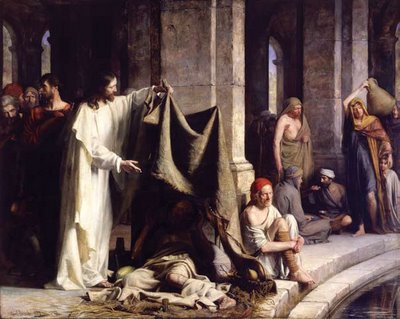
The MOA will soon be featuring the long-awaited Carl Bloch exhibit entitled Carl Bloch: The Master’s Hand.  Opening November 12, 2010 on the museum’s main floor, this exhibit will literally bring viewers into Danish churches. Over ten years in the making, the show includes five magnificent altarpieces, a major accomplishment and gathering never before seen (in an all Bloch show). These altarpieces have not been reunited since their original placement in separate churches during the early 1800s. Alongside the altarpieces, are featured Bloch’s more humorous lithographs and etchings such as “The Roman Barber,” as well as more serious depictions of Jesus Christ. Dawn Pheysey, the curator of religious art, has traveled to Denmark and Sweden multiple times throughout these ten years to gain connections, establish trust, and create networks with European curators.


If Bloch seems unfamiliar to you, I am certain you have unknowingly seen his works in LDS Meeting Houses and as a main artist in The Church of Jesus Christ of Latter-Day Saints’ new publication The Gospel Art BookUnderstanding the significance of Carl Bloch to the LDS community, I find myself extremely disappointed in the direction the MOA has chosen to take for the show's education. For this exhibition, it has been decided that the docent program of guided tours will not be effective. Rather, an iPad will be given to small groups of individuals as they enter the exhibit. On this iPad, small icons will represent each altarpiece and, when touched, will bring up information for viewers.


I am thoroughly discouraged by this effort to educate the community. I worry that viewers will be looking more at electronic devices than discovering the beautiful altarpieces for themselves. After ten years of work to get these works, the community will be more prone to gaze upon an iPad than the art. Learning opportunities, as I see it, will inevitably decrease as human interaction decreases.


What are your thoughts on this new implementation? Do you believe this way of educating the public will be effective?

Tuesday, October 19, 2010

AHA Halloween Party

Flyer designed by Claire Smith

October 26, 2010, 8:00 - 9:30 pm. 255 UPC (on the corner of University and University). Costume contest (wear your best art related costume), games, food, etc. See you there!